
Ask a question.Get the exact episodethat answers it.

570+
Episodes indexed
100%
Answers cited to the minute
2
Integrations
Spotify + Apple
$0.02
Average cost per answer
01The Client

Swisspreneur

The Swisspreneur Podcast cover art: the swisspreneur wordmark over a grid of red, blue, and pink half-circles.

Switzerland's #1 platform for entrepreneurs.

Swisspreneur runs a long-form interview podcast, a Slack community of 700+ founders, and an investment syndicate that has channelled CHF 3M+ into startups.

The show is the centre of gravity. 570+ episodes of candid conversations with founders about fundraising, hiring, scaling, and failure.

swisspreneur.org
02The Challenge

A growing archive that was getting harder to use.

Swisspreneur had a deep archive and a real question: was there something genuinely useful to do with AI here, or was it just noise? The constraints were set before the first line of code. Weeks, not quarters, and a community-org budget.

01

Linear audio is the opposite of searchable.

570+ episodes hold years of operating context, and the format keeps all of it invisible. None of it can be queried until it's transcribed and indexed.

Locked in audio
02

No way to reach the relevant moment.

Even when the answer existed, finding it meant remembering which episode it lived in. That mental index didn't scale past a handful of memorable moments, and newcomers met hundreds of titles with nowhere to start.

No way in
03

It had to ship in weeks.

The assistant had to be in front of the community in time for their Scale Up Cruise, not after a half-year build. That set the shape of everything: prove it on a slice, ship a thin surface, expand in stages.

Weeks, not quarters
04

It had to be cheap to run.

A demo that works once but costs a fortune per month at archive scale isn't a solution. The constraint was as much financial as technical, from day one.

Community budget
03The Solution

The archive didn't need a new format. It needed a way in.

Transcription, retrieval, and grounded generation turn the same hours of audio into something a founder can ask a question of, and get a cited answer back in seconds.

Archive
570+ episodesHundreds of hours of audioLinear episode listNo searchWall of content for newcomers
Instant Answers

Ask Swisspreneur

One questiona grounded answercited straight to the episode

Operable after handoff

A small, managed AWS footprint the team can run without a dedicated platform engineer. Infrastructure as code, and budget alerts from day one.

04Decisions

Three calls that shaped the build.

01

A widget, not a separate destination.

The assistant ships as an embeddable widget inside Swisspreneur's own site, in its icon and its brand. Nobody has to go somewhere new to ask a question. It opens with the promise stated up front and the questions people ask most, so a first-time visitor has somewhere to start instead of a blank input. One embed, one retrieval pipeline: answer quality is owned in one place.
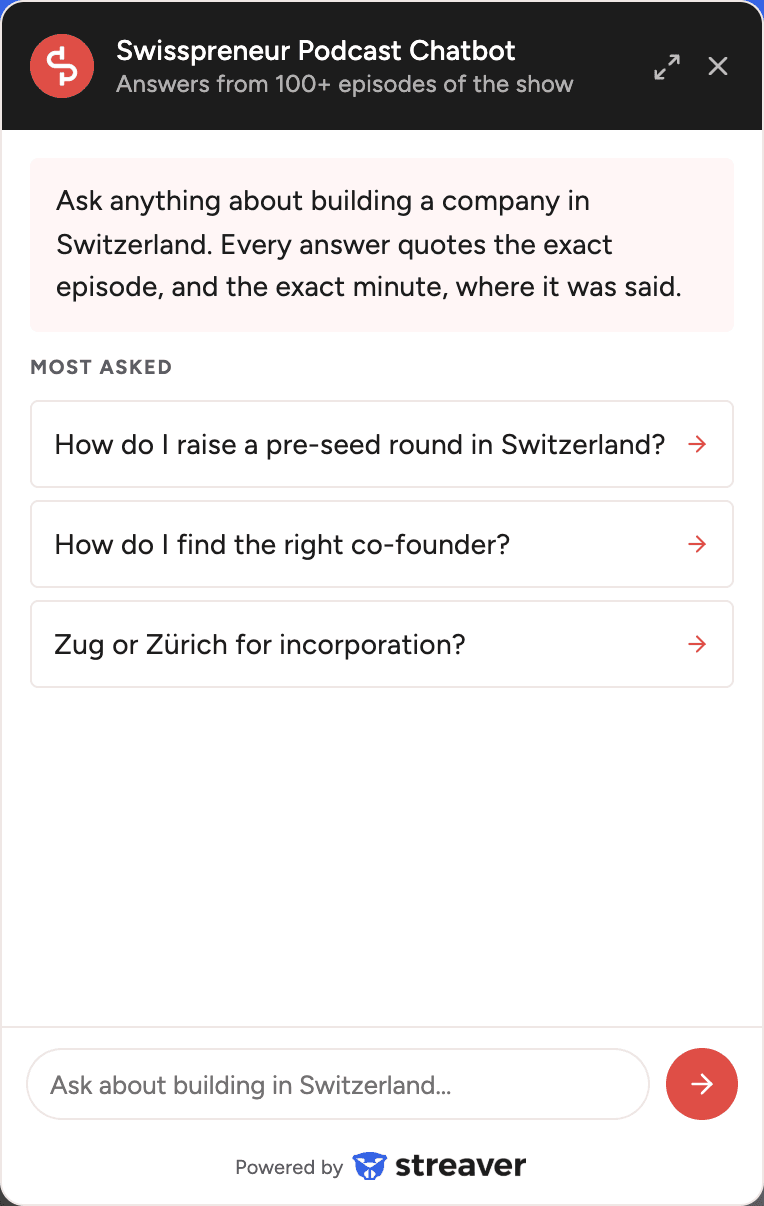
The Ask Swisspreneur widget open on its entry state, inviting a question about building a company in Switzerland and offering three suggested questions: raising a pre-seed round, finding a co-founder, and choosing between Zug and Zürich for incorporation.
02

Every answer cites its episode.

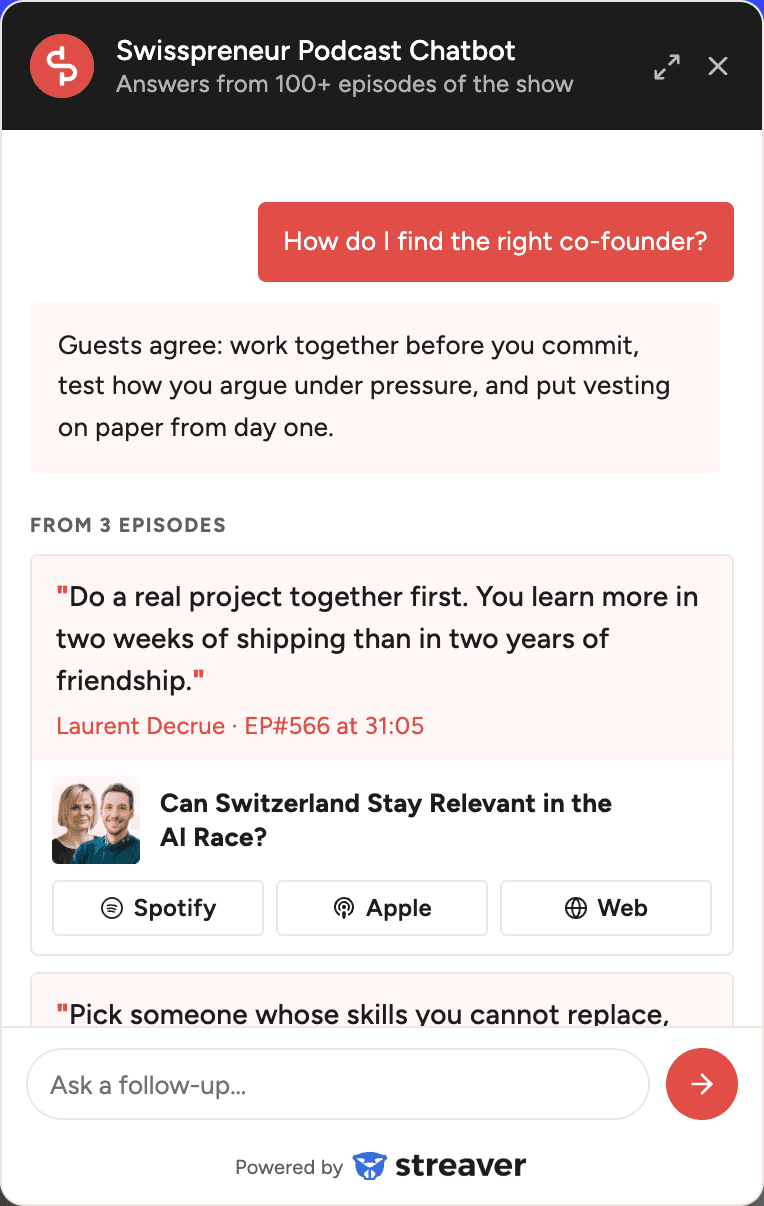
Every answer carries its source: the quote, the guest, the episode number, the exact minute, and links straight to Spotify or Apple. When the answer spans the archive, the assistant draws from several episodes at once and cites each one. That's the difference between a generic chatbot and a research tool.

A multi-episode answer: a synthesized reply drawn from three episodes, each with its own quote, guest attribution, episode number, timestamp, and links out.
03

Managed AI stack, sustainable economics.

Managed retrieval, cheap vector storage at archive scale, managed transcription. Deliberately boring on the operational side, so the budget stays predictable and nobody needs a dedicated ML platform engineer. Per-query cost decides whether the community uses the assistant freely or rations it, so it was designed in rather than measured after. A typical answer lands around $0.02.

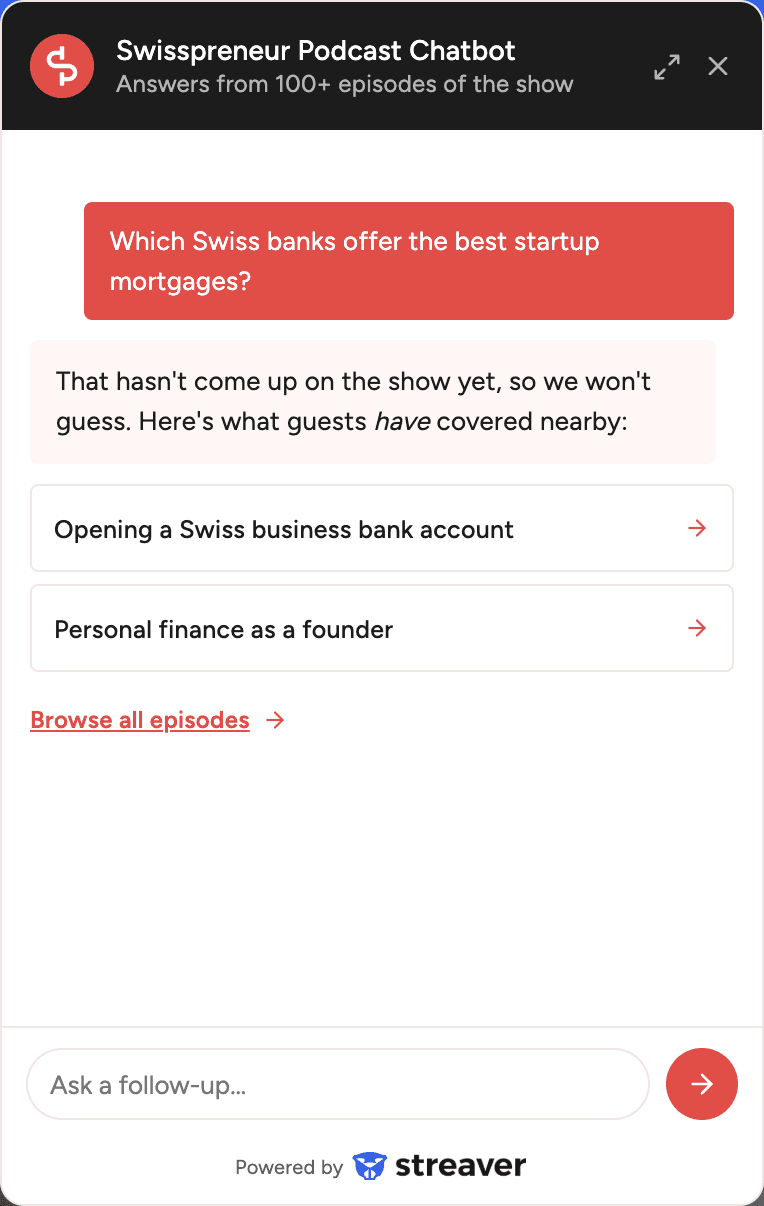
The Ask Swisspreneur widget gracefully declining a question the archive hasn't covered, and suggesting the nearest related topics instead of guessing.
05Results

What changed for Swisspreneur.

  • Linear, un-searchable audioInstant, cited answers

    The archive became askable.

    A founder's question hits the archive and comes back with the specific episode that answers it, not a wall of results.

  • Wall-of-content drop-offAsk a question, get episodes

    Newcomers got a front door.

    Instead of scrolling hundreds of titles, a visitor starts from something they care about and follows it into the catalog.

  • AI too expensive to leave onCents per answered question

    The cost stayed inside a community budget.

    Transcription rolled out in stages keeps the running cost where it needs to be, so the assistant stays on for everyone rather than rationed.

06Timeline

How it came together, week by week.

  1. Before kickoffProof of conceptA prototype on a slice of the archive validated transcription quality, retrieval, and answer grounding, and produced the first cost math.
  2. Week 1Investigation and infrastructureArchitecture planning, ingestion cost calculation, and a test ingestion of a few episodes, proving the pipeline end to end before committing to the full catalog.
  3. Week 2Build and connectThe widget prototype, wired to the knowledge base. A plain-language question comes back with the source episode, the minute, and links out.
  4. Weeks 3–4PolishThe widget UI and its states, plus the quality and format of the answers themselves.
  5. Weeks 5–6Feedback and testingFeedback and testing to harden the assistant before the Scale Up Cruise.
07Stack

Managed AI. Sustainable economics.

Picked for cost-at-scale and operability after handoff: managed inference, retrieval that holds up at archive size, and a substrate the team can run without a dedicated ML platform engineer.

  • Amazon Bedrock Knowledge Base
  • S3 Vectors
  • Bedrock Data Automation
  • Claude Sonnet
  • Next.js embeddable widget
  • AWS CDK
They didn't sell us on the magic. They built a one-hour proof of concept that showed us exactly what was possible and where the trade-offs were. That's why we trusted them with the archive.
Silvan Krähenbühl
Silvan KrähenbühlManaging Director · Swisspreneur
08Why us

Why Swisspreneur trusted us with the archive.

AI features for community products either feel native or get ignored. The choice wasn't about who could build the cleverest model, but who could ship something the community would reach for.

The value sat inside long-form audio, which makes this a transcription and retrieval problem, not a search bar added to a website. And the economics are part of the engineering: the stack holds up at archive scale, not just in a demo.

  • Audio-to-knowledge expertise.

    The value sat inside long-form audio. That meant transcription, semantic retrieval, and grounded generation — not a search bar bolted onto a website. Streaver builds audio-to-knowledge systems and could speak to the trade-offs without hand-waving.

  • Product design for community.

    A community product has to fit existing habits, not impose new ones. The assistant had to feel native to how Swisspreneur's audience already moves through the site — a drop-in widget, not a chatbot parachuted in from somewhere else. Product design was scoped in from the first conversation.

  • Sustainable AI-stack expertise.

    A managed AWS stack picked specifically because the cost profile holds up at archive scale. The financial design of the stack is part of the engineering, not an afterthought once the demo works.

09The Team

A small team, in it from day one.

Streaver works as a partner, not a pair of hands. The team was in it from day one — bringing ideas to the table, helping make the calls, and finding the option that actually fit.

  • Feld
    Feld
    Engineering & direction

    Held the thread between Swisspreneur and Streaver, and doubled as a second brain on the engineering: architecture and direction.

  • Cate
    Cate
    Product Designer

    Drove the initial discovery and design — shaping the widget's interaction and how a cited answer is presented, so the assistant feels native to Swisspreneur's brand rather than bolted on.

  • Tano
    Tano
    Core engineering

    Core engineering across the build: the ingestion pipeline (episode audio + metadata → Bedrock Data Automation → knowledge base) and wiring the widget to grounded, cited answers.

  • Fiti
    Fiti
    Engineering

    Copilot and second brain on the engineering effort — the embeddable widget and its states, and iterating on the UI and answer quality.

Sitting on a content archive nobody can search?

AI is the unlock. Done thoughtfully.

Podcast networks, associations, internal training libraries — anyone holding hours of audio or video nobody can search. Done thoughtfully, AI turns it into a community feature, not a chatbot bolt-on. Talk to us about a Knowledge Hub for your archive.