Case Study · 01012-week MVP · ongoing

One platform for an entire robotics ecosystem.

Client
Pittsburgh Robotics Network
Sector
Nonprofit · Member association · Robotics & AI
Engagement
Member platform build
Duration
12-week MVP + ongoing
Members served
100+ organizations
Tools consolidated
5 → 1
5 → 1Tools consolidated to one platform
12 wksFrom kickoff to live MVP
100+Member organizations served
2h/dAdmin hours reduced
01A nonprofit serving a high-tech community.

When the community is the product, the tools running it have to keep up.

Type
Nonprofit · 501(c)(3)
HQ
Pittsburgh, Pennsylvania
Members
100+ robotics organizations
Ecosystem role
Hub for U.S. robotics & autonomy
Engagement model
Fixed-fee MVP · retainer ongoing

Pittsburgh Robotics Network is a key hub in the U.S. robotics and autonomy ecosystem — connecting professionals, researchers, and more than 100 companies building robotics. Its value is the community itself: who's in it, what they get, and how easy it is for them to participate.

Operations ran on five disconnected tools. MemberClicks held member records. Spreadsheets tracked benefits. Eventbrite ran events. Email lists handled comms. Sponsor outreach lived in someone's inbox. Each system stored a piece of the member picture; nothing stored the whole thing.

Staff burned hours every week on reconciliation. Members had no unified place to see what their membership actually got them. Some paid for events that were supposed to be free — a quiet erosion of trust that nobody on a lean team had time to fix.
02The Challenge

A community held back by its own tools.

None of these problems were dramatic on their own. They were just constant — and on a lean nonprofit team, constant is the most expensive kind of problem there is.

01

Five tools, zero integration

MemberClicks, spreadsheets, Eventbrite, email lists, manual reconciliations, sponsor outreach — five systems and a handful of inboxes. None of them talked to each other. None of them stored the full picture of a member.

Fragmentation
02

Manual reconciliation burden

Every week, staff matched event lists against member rosters, copied benefits assignments into spreadsheets, and chased down sponsor commitments by email. The work wasn't hard. There was just no end to it, and it scaled with every new member.

Operations
03

No single source for members

Members couldn't see, in one place, what their membership actually included. Benefits, event access, sponsor perks, invoice history — each lived in a different system, or nowhere at all. The experience didn't match the community PRN had built.

Member experience
04

Mistaken paid registrations

PRN events are free for members. But because Eventbrite didn't know who was a member, members occasionally paid for events they were entitled to attend at no cost. A small problem that mattered: nonprofits cannot afford to look careless with their community's money.

Trust erosion
We went from chasing data across five tools to running the whole community from one screen.
Josh LucasTBDDirector of Programs · Pittsburgh Robotics Network
03Selection

Why PRN chose Streaver.

Nonprofits don't need to be sold to. They need to be heard. The three reasons below are the ones PRN named back to us — not our pitch, their words.

Built for the budget, not for enterprise SaaS.

Off-the-shelf association software was either too rigid or priced for enterprises, not nonprofits. PRN needed a partner who understood that a nonprofit budget isn't a smaller version of an enterprise budget — it's a different problem. We built around how PRN actually works, not how a SaaS vendor wishes it worked.

Integration without new lock-in.

Consolidation can't mean replacing one lock-in with another. We chose to integrate with Eventbrite rather than rebuild it, migrate cleanly off MemberClicks rather than wrap it, and design the data model so PRN owns it outright. The platform reduces vendors; it doesn't add a new one PRN can't leave.

Fast MVP, delivered.

A nonprofit can't wait six months to see whether a build is going to work. We scoped a 12-week MVP that put a working portal in members' hands, then iterated against real usage. Requirements kept evolving — as they always do — and a short MVP horizon kept us honest about what mattered first.

04The Drop

Five tools became one.

The platform is a consolidation, not a replacement. Eventbrite still runs events. Stripe still processes payments. PRN owns the data model that ties them together — and that's the part that makes everything else stop being a problem.

Five tools → one platform
MemberClicksSpreadsheetsEventbriteEmail listsManual reconciliationsSponsor outreach

One PRN platform

Members · benefits · events · sponsors — one source of truth

+ Image placeholder

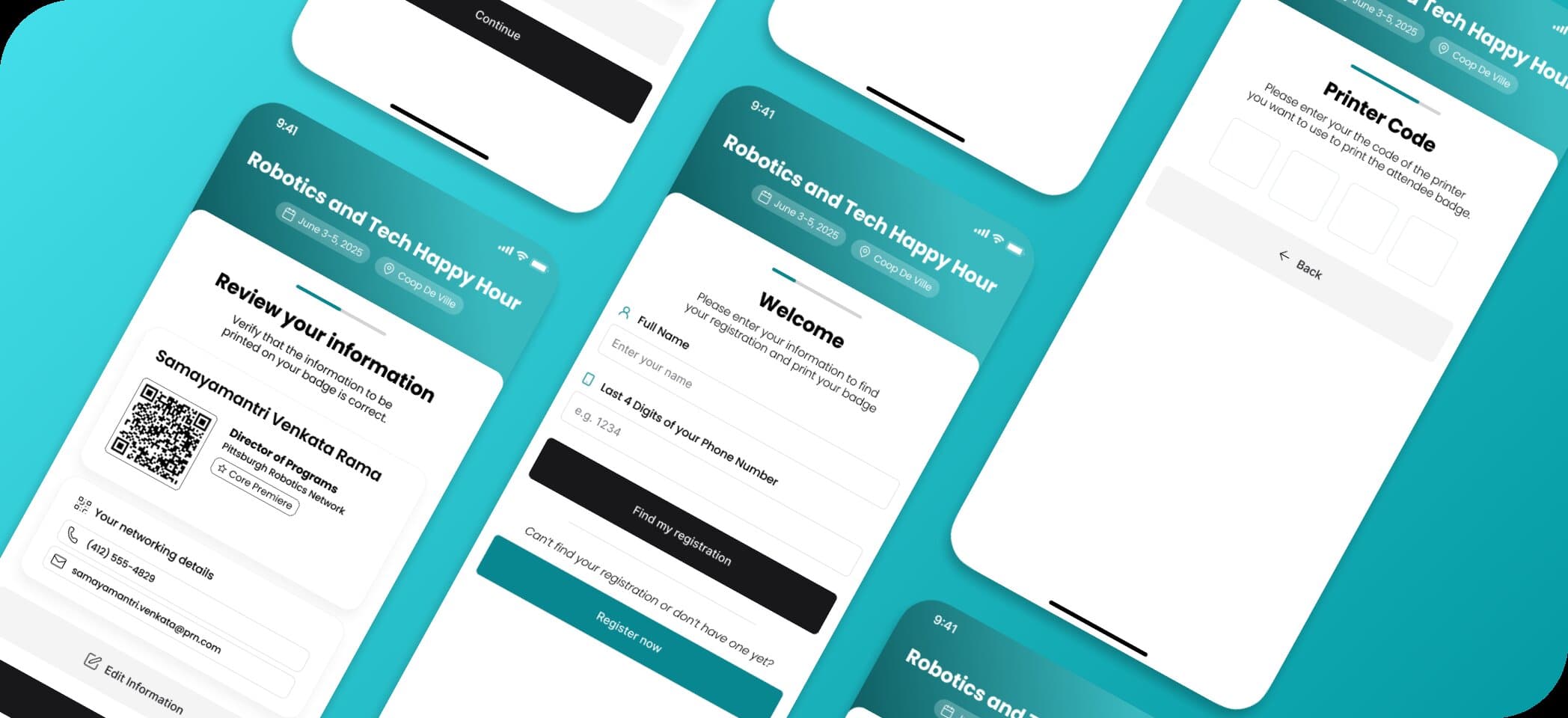
Member portal screenshots — the dashboard a logged-in member sees today — paired with a before-state fragmentation map of the five disconnected tools the portal replaced.

05Decisions

Three calls that shaped the build.

01

One data model, owned by PRN.

Instead of replacing one vendor with another, we designed a unified data model that holds members, benefits, events, and sponsors in one schema PRN owns. Every downstream feature — the portal, the calendar view, the sponsorship workflow — reads from the same source. There is no longer a question of which system is right.

PrincipleConsolidation only counts if the client owns the model afterwards. Otherwise it's just a different brand of fragmentation.
02

Self-service member portal.

Members can now sign into a portal and see everything: assigned benefits, delivery history, invoices, upcoming events, and their own contact and logo data — editable in place. Staff stop being the search interface for the membership. Members stop emailing to ask what they're entitled to.

03

Eventbrite sync via smart redirects.

Eventbrite isn't going anywhere — it's where PRN's events live and where attendees expect to register. So instead of replacing it, we sync events into the portal and route members through a smart redirect that drops them onto the free-ticket path. Mistaken paid registrations stop happening because the wrong path no longer exists for a logged-in member.

DetailInvisible to the user. Members don't learn a new flow; they just stop being charged for events they were entitled to.
06Honest

The numbers we don't yet have.

We're writing this case study without the % reductions that would make a slicker version of it. That's on us. Here's what we know, what we don't, and what we'd instrument differently next time.

Measurement gap

We didn't quantify the manual-work reduction.

We can describe what changed — staff time freed up, mistaken payments ended, members navigating to one place — but we don't yet have a board-ready % for manual-work reduction. That's a measurement we should have instrumented from week one. We're proposing it as the first thing to add in the next cycle.

Baseline gap

We can't count the mistaken payments before.

Mistaken paid registrations stopped after the Eventbrite sync went live. We know they stopped because the failure mode no longer exists. We don't, however, have a count of how many of those incidents happened before — the historical data lived in email threads, not a system. The fix is real; the baseline isn't tidy.

Process gap

Portal adoption isn't instrumented yet.

We launched the portal at week 8 and assumed adoption would be self-evident. It mostly is — but we didn't add analytics until later, so the early-weeks usage curve is anecdotal rather than measured. Standard product hygiene we'd insist on from day one in the next engagement.

07Outcomes

What changed for PRN.

Each outcome below is paired with its before-state. The figures we haven't quantified yet are marked TBD — the next phase of the work includes putting numbers on the ones that matter.

Hours every week, on every stafferReduced (TBD %)

Manual administrative work

Reconciliation across MemberClicks, spreadsheets, Eventbrite, and email lists is gone. The exact % saved is the next thing to measure — staff time is being put back into program work, not data entry.

TBD · engineer to verify
Members occasionally charged for free eventsPath no longer exists

Mistaken paid registrations

Logged-in members are routed through a smart redirect to their free ticket. The failure mode is structurally eliminated, not just papered over.

Five tools, none of them completeOne portal, one source of truth

Member experience

Members see benefits, delivery history, invoices, events, and their own editable data in one place. The experience finally matches the community PRN has built.

Lean team buried in reconciliationStaff time returned to program work

Staff productivity

The team that used to spend hours matching lists now spends those hours on programming, partnerships, and community growth — the work nonprofits actually exist to do.

Five vendor data models, none compatibleSchema PRN owns, extends as it grows

Foundation for community features

The unified data model is the foundation for everything that comes next — sponsorship analytics, member directories, networking features — without re-platforming.

Unknown — first build for this clientProven on a real nonprofit engagement

12-week MVP cadence

The 12-week MVP cadence held despite evolving requirements. We now use it as the default shape for nonprofit clients with a similar consolidation pattern.

08The Team

A small Streaver team. PRN's lean staff. Weekly working sessions.

We worked directly with the program team — no project-manager intermediary, no translation loss. The three people below are who PRN met, who built it, and who they call when something needs attention.

Tano
Tano
Senior Full-Stack

Senior full-stack engineer across the member-platform build — portal, integrations, and the unified data model.

Gastón Yebra
Gastón Yebra
Semi-Senior Full-Stack

Full-stack engineer building member-portal features across the stack.

Cate
Cate
Designer

Product designer for the member portal — information architecture, flows, and interface.

How the engagement is structured

Cadence

Weekly working session with PRN's program team. Async updates in a shared channel between sessions. Decisions made in the room, not in three follow-up emails — PRN's team is lean and protected from meeting overhead.

Communication

We work directly with the program team, not through a project-manager intermediary. Requirements come from the people who feel the pain; the team that built the platform is the team that hears the feedback. No translation loss.

Pricing

Fixed-fee for the 12-week MVP, scoped against a written list of what was in and what wasn't. Ongoing work runs on a small monthly retainer for enhancements and operations. Nonprofit budgets need predictability; we give it.

IP transfer

All code, data, and infrastructure ownership transfers to PRN at delivery. Streaver operates the platform under retainer, but PRN can take it in-house, change vendors, or extend it themselves at any time. No lock-in is the point.

Twelve weeks to live, plus what came after

WEEK 00Data audit & discoveryWalked through all five systems with PRN's program team. Catalogued every place a piece of member data lived and every workflow that touched it.
WEEK 04Model & architectureUnified data model agreed. Portal architecture finalized. First migration scripts running against a copy of the MemberClicks export.
WEEK 08Portal MVP launchSelf-service member portal live in PRN's hands for the first time. Members can see benefits, invoices, and their own profile data.
WEEK 10Eventbrite sync liveEventbrite sync and smart redirect deployed. Mistaken paid registrations stop happening — the path that caused them no longer exists for logged-in members.
WEEK 12Full platform liveFull platform delivered. Members, benefits, events, and sponsors operating from one source of truth. Spreadsheets and manual reconciliation retired.
WEEK 24Sponsorship workflow addedSponsorship application workflow added — companies apply per-event from their portal, with notifications routing automatically to PRN's program team.
09Stack

Boring choices, on purpose.

A nonprofit platform should be cheap to run, easy to hand off, and durable. That ruled out a long list of more interesting choices and left us with the ones that almost always work.

Languages & Framework

  • TypeScriptstrict, across the platform
  • Node.jsLTS, services and API

Data & Infrastructure

  • PostgreSQLprimary database, single source of truth
  • AWShosting, storage, and managed services

Integrations

  • Eventbrite APIevent sync and smart redirects
  • MemberClicksone-time data migration off legacy
  • Stripeinvoices and member payments
10What's Next

The next phase of the platform.

With the unified data model in place, everything that comes next is an addition, not a re-platforming. That's the whole point of doing the consolidation in the first place.

Advanced benefits reporting.

Benefits delivery, sponsor performance, member engagement — all sitting on the unified data model, waiting to be surfaced. The next phase is reporting that lets PRN's team and its sponsors see, at a glance, what the membership is actually getting.

Sponsorship platform expansion.

Sponsorship today is a per-event workflow. The platform can carry a richer sponsor relationship — multi-event packages, year-round benefits tracking, renewal automation — without adding another system. We scope this as PRN's commercial side grows.

Community features — directory & networking.

PRN's value is the network. A member directory and lightweight networking features (intros, expertise tags, contact requests) turn the portal from an admin tool into something members open for its own sake. The data model is already ready for it.

Lean nonprofit team buried under fragmented tools?

We build exactly what you need — on a nonprofit budget.

Streaver builds member platforms, consolidation tools, and operations software for nonprofits and associations. Fixed-fee MVPs. IP transferred to you on delivery. No vendor lock-in.

11Continue reading
DELOS AG
Featured
Live

DELOS AG

First paying enterprise customers in sixteen weeks

91% precision · 4-agent systemRead the case study
Supreme Golf
Featured
Live

Supreme Golf

Building a $1M product for $125K with a non-technical CEO at the keyboard

8× lower cost · 3–5 deploys/dayRead the case study