
Association
American Institute of Architects
48% lower costs across six mission-critical products, with no team handover
Read the case studyOn Saturday, September 5, our CTO sat on the main stage of Antel Arena to argue about a question every product team is asking this year: which AI to adopt, and which to ignore. An hour later, in a smaller room, one of our engineers told a full house that there is already an AI working inside their companies that nobody hired. Half an hour after that, our People & Talent Manager was back on the main stage debating what a developer needs to know when the tools change every quarter, and somewhere in between, our VP of Engineering sat at a table explaining how to lead the people going through all of it.
Meanwhile, twenty meters away, a line of people was waiting to play a video game our engineers built in about 10 hours, with an AI as their coding partner, at two internal hackathons.
That was our IT Builders Live 2026. Five people on stage, one stand that never emptied, and a day that answered the question in the title more honestly than any keynote could. This is what happened, what was said, and why an AI engineering team from Montevideo keeps spending its Saturday here.
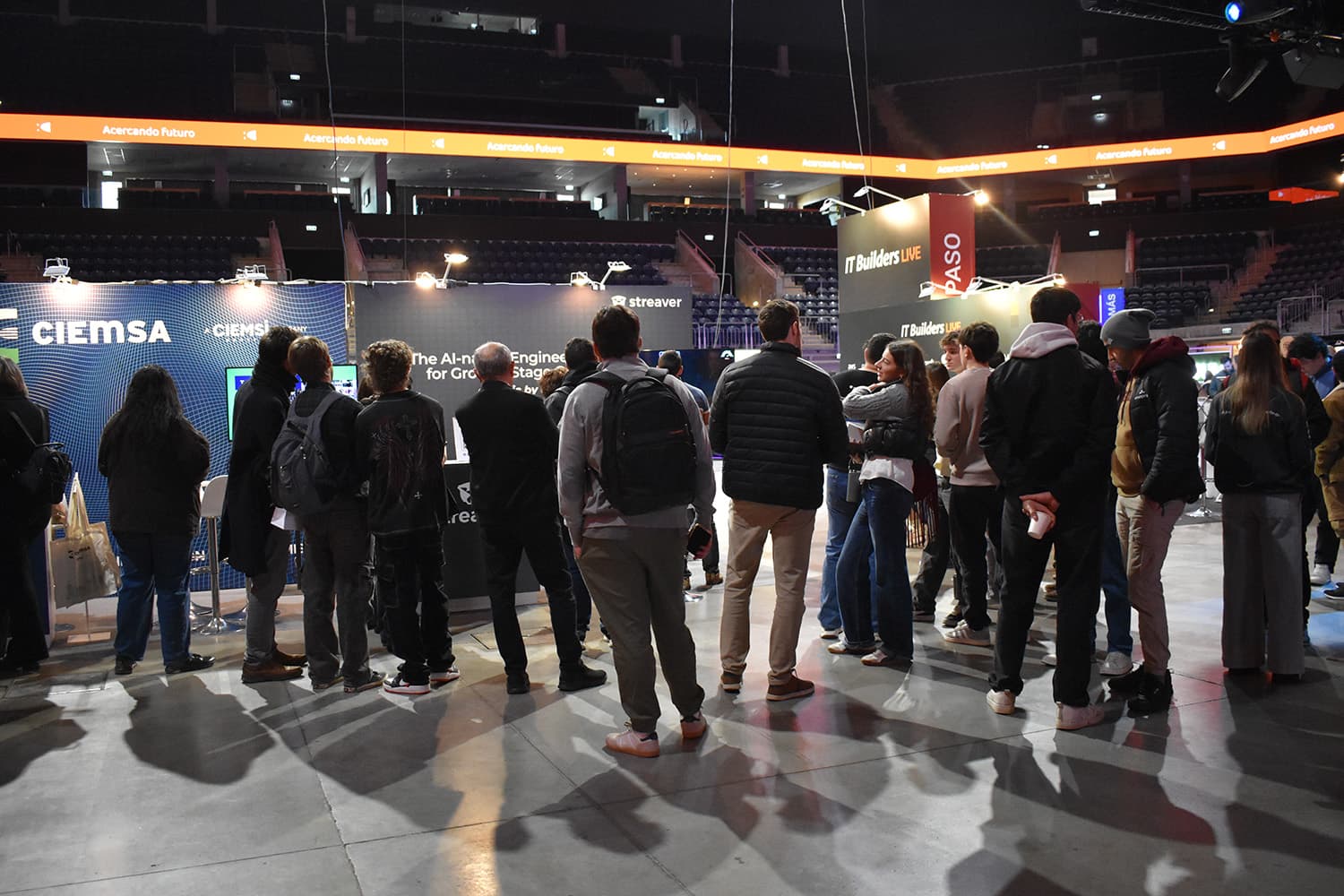
IT Builders Live is the largest technology event in Uruguay: one full day at Antel Arena, Montevideo, with more than 100 activities running in parallel. Conferences, thematic panels on the main stage, workshops and masterclasses, expert roundtables, a startup competition, an executive networking track and an expo floor where the country's tech companies set up their stands. Developers, students, executives and the universities that train the next generation of engineers all share the same building for a day.
For a company like ours, it is the one day a year when the whole Uruguayan tech ecosystem is in one room. That is why we have sponsored it three years running.
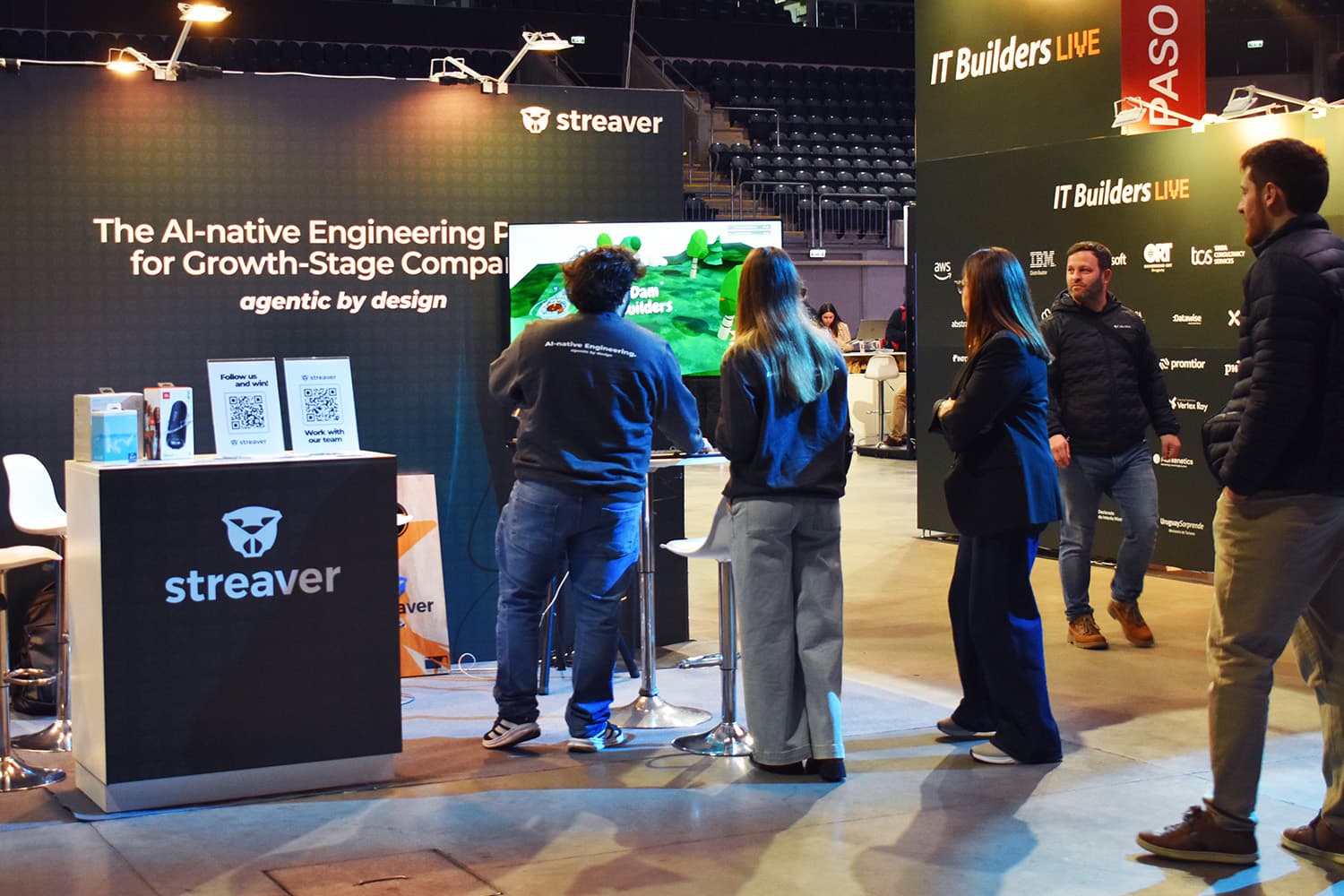
Our first year, we showed up with a stand and a game. The game was a hit, and it still is: people who played it in the first edition came back looking for it this year. Our second year, we came back with more prizes. This year, the stand was the same, but the balance shifted. Five people from Streaver were on stage or at an expert table, and more than twenty were working the stand in shifts.
That shift is deliberate. We push our team to present, not just attend. It takes people out of their comfort zone, and it forces us to say out loud, in public, what we actually believe about building software with AI.


Photo 1 of 10
The stand did not empty from open to close, and most people stopped for the game.
Dam Builders is a video game we built ourselves for the event. The idea came from our marketing team; the build happened at two internal hackathons, with Claude as our coding partner. Total build time: about 10 hours, spread across separate days, plus a few tweaks the days before the event. We tell that number on purpose. A game good enough to keep a stand full for eight hours used to be a month-long side project or something you outsourced. In 2026 it was two afternoons of engineers having fun with the same tools they use for client work.
The scores tell the rest. Ismael Medina took first place with 145 points and left with the full Streaver merch pack and a JBL speaker. Misael Payret finished three points behind at 142 and took the Streaver sports kit with waterproof sport earbuds. A separate Instagram giveaway at the stand sent a gamer headset home with Mateo Seijo. And Inés Vaz, who had won the two tickets we raffled the week before, spent the day at the event with friends.


Photo 1 of 4
Dam Builders is coming to our website, so the 145 is not safe.
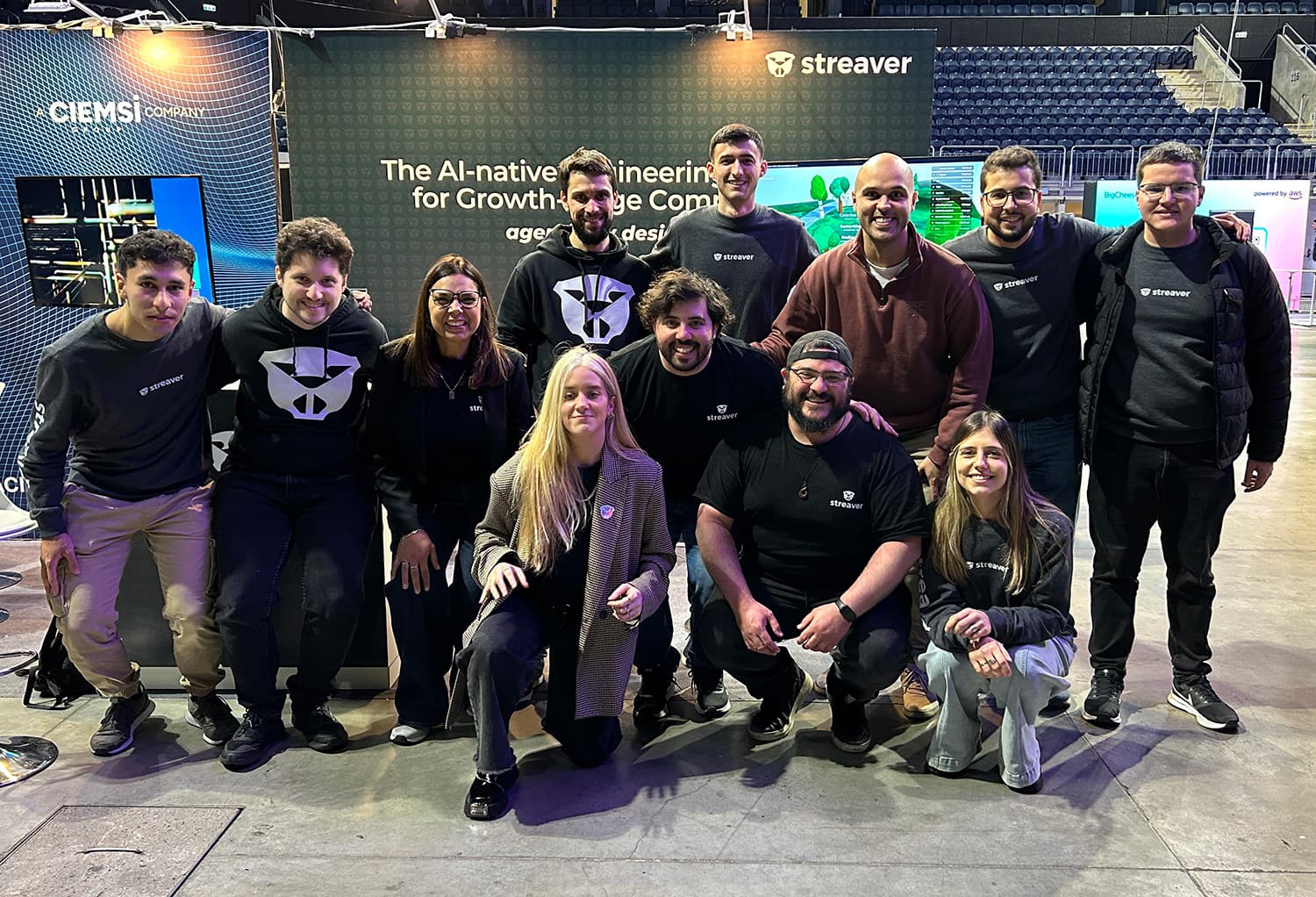
One detail from the stand that nobody planned: the new Streaver merch was finished right before the event, and the whole team showed up wearing it without anyone asking. Twenty people in matching hoodies is not a branding strategy. It just looked like one.
Federico Kauffman, our CTO, took the main stage at 2 pm for the panel "Revolución IA: ¿qué adoptar y qué ignorar?", alongside Alejandro Goldín (Maximstore), Nicolás Domínguez (Tata Consultancy Services), Alex Bonjour (Vertex Ray) and Sebastián Vergara (IBM). It is the question we get asked most by the product teams we work with in the US and Europe, and our position on it has not changed since we started shipping AI features into production: the demo is never the hard part. Getting from a demo to a system that users trust, that costs what a business can sustain, and that someone can maintain after launch, is the whole job.


Photo 1 of 4
Danilo Espino, one of our engineers, gave his own talk on Stage B at 3 pm: "La IA que no contrataste: Shadow AI". He built it around two industry figures, 98% of organizations already live with AI tools nobody authorized, and by the end of 2026 around 40% of enterprise applications will embed autonomous agents, and made the case that the risk has changed shape: the unauthorized tool is no longer a chatbot giving answers, it is an agent that reads, decides and executes. The governance gap, in his view, is an ownership problem before it is a technology one. He then took the same conversation to the cybersecurity experts' table.


Photo 1 of 3
Rosina Varela, our People & Talent Manager, was back on the main stage at 3:30 pm for "Cómo prepararse en la nueva era laboral", moderated by Mariana Carrau (ManpowerGroup), with Juan Marrero (UTEC), Cecilia Belletti (Universidad ORT), Celia Zunini (Universidad de Montevideo) and Florencia Sagarra (Tata Consultancy Services). Three universities, a global staffing firm and a large IT services company on one panel says where the question sits: the people teaching engineers, placing them and hiring them are all working out what a developer needs to know when the tools change every quarter. Rosina was there as the one who hires for a team that builds with AI every day.


Photo 1 of 3
Nicolás Alonso, our VP of Engineering & Delivery, took the experts' roundtable on leading technical teams. The roundtable format is small and unscripted, closer to a conversation than a talk, which suits the topic: leading engineers through a tooling shift is not a keynote problem, it is a Tuesday-afternoon problem.
Three things, in order of how much they matter to us.
The team showed up. Over 80% of the company, on a Saturday, by choice. Behind that number are the people who did the heavy lifting before and after: Julie, our office manager, had the new merch, the logistics and the prizes ready; Rosina organized the stand shifts on top of her own panel; Lucas, our stand host every year, kept a line of people playing and following us on Instagram all day.


Photo 1 of 17
The conversations were the same ones we have with clients. Which AI to adopt, how to govern what is already inside the company, how to hire for it, how to lead the people doing it. The questions asked in Montevideo are the ones our clients ask in the US, Switzerland, and the rest of Europe, and debating them in public keeps our answers honest.
And the game worked. Not just as a stand attraction, but as a small proof of how we build: an idea from marketing, two hackathons, one AI coding partner, about 10 hours, and a full stand.
Thanks to IT Builders for the space and for a great event.
Want to spend next year's IT Builders Live on our side of the stand? We're hiring
48% lower costs across six mission-critical products, with no team handover
Read the case study
Three AI agents went dark. We brought them back in three months.
Read the case study
Senior engineers who shipped from day one and replaced a team in a $350B market
Read the case study
Vercel Ship 2026 is on October 15 at the Palace of Fine Arts, San Francisco. The date, speakers, how to watch online, and why Streaver will be there.
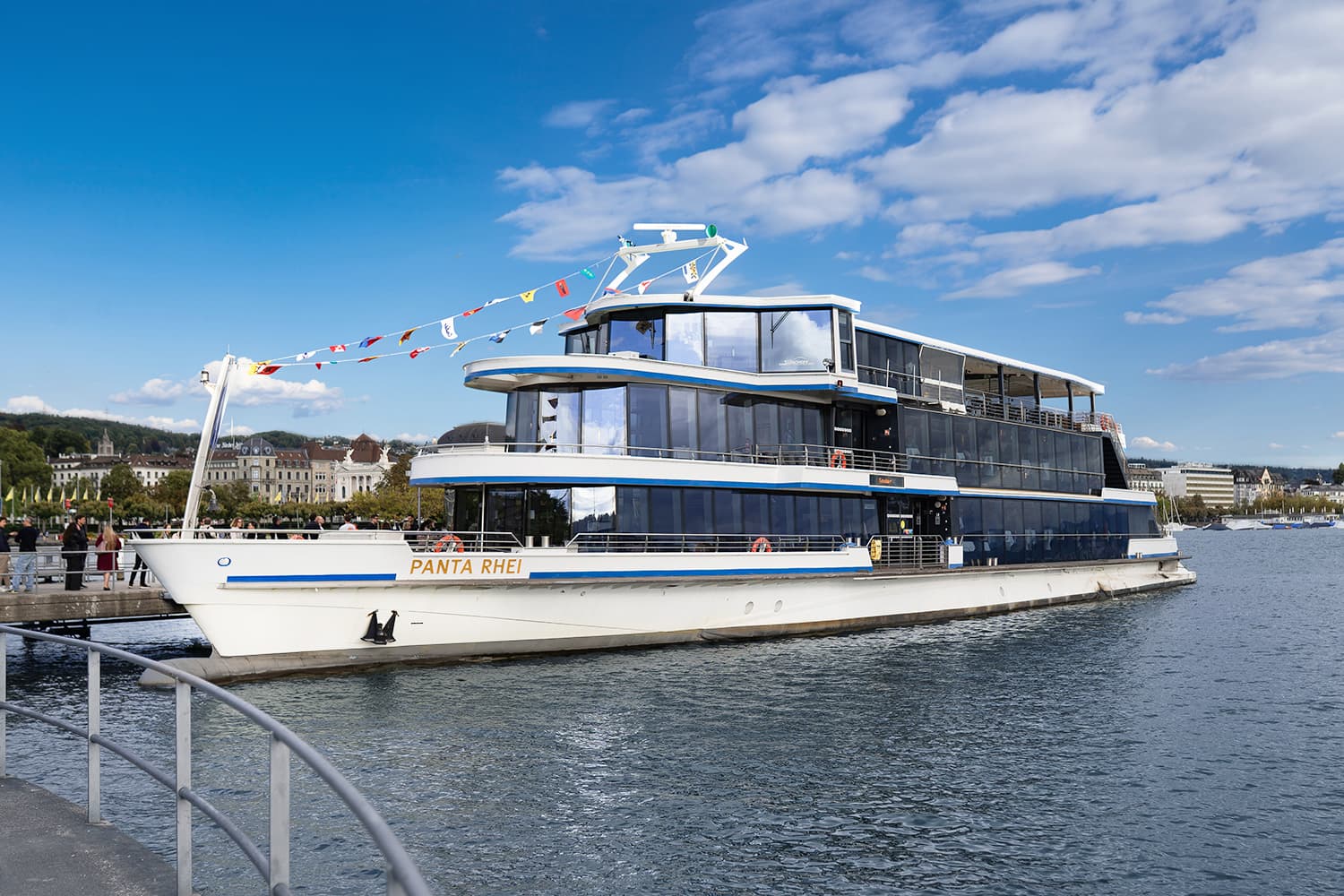
Everything about Swisspreneur's Scaleup Cruise Zurich 2026: September 10, Lake Zurich, 150+ founders and investors, and why Streaver will be on board.
A curated calendar of the top 25 software conferences to attend in 2026 — across AI, cloud, developer tools, and enterprise platforms — with dates, locations, and official links so you can plan with confidence.
Streaver embeds senior product teams inside companies building AI-native software, from whiteboard to live customers.
Talk to us