Case Study · 005Team augmentation · ongoing partnership

Senior engineers who shipped from day one.

Client
Propelicy
Sector
Insurtech · Medicare contracting · U.S.
Engagement
Team augmentation · ongoing partnership
Industry stage
$350B Medicare Advantage market
Contracts moved annually
2.3M+ across 800+ carriers & FMOs
Embed model
Senior full-stack · owner-style
$350BMedicare Advantage market
2.3M+Contracts moved annually
All-starWorking speed lift — per CEO
TBDTime to first PR after embedTBD
01A team that was already great. We added muscle.

When restructuring leaves a capacity gap, you don't need a rescue — you need power hitters.

Industry
Insurtech · U.S. Medicare
Market size
$350B Medicare Advantage
Annual contracts
2.3M+ across 800+ carriers & FMOs
Engagement model
Team augmentation · ongoing
Streaver pattern
Embed — not rescue, not build

Propelicy is rebuilding Medicare contracting for an industry that still runs much of its $350B annual flow on paper and ad-hoc spreadsheets. More than 2.3 million contracts move every year between 800+ carriers and field marketing organizations (FMOs) and the broker networks they pay. Propelicy is unifying that whole flow — from lead generation to enrollment — into a single multitenant platform.

The work is hard for the same reason the opportunity is large: Medicare is regulated, the data is sensitive, the carriers and FMOs are heterogeneous, and the existing tooling is a patchwork. The platform has to be modern, multitenant, and compliant — while the existing app stays online for the customers already on it.

Mid-restructuring, Propelicy hit a capacity gap at exactly the wrong moment: they needed to ship the next-generation platform and maintain the existing one in parallel. They didn't need a rescue. They didn't need a build-from-scratch shop. They needed senior engineers who could integrate in days, ship to production safely, and lift the bar of the team they joined.
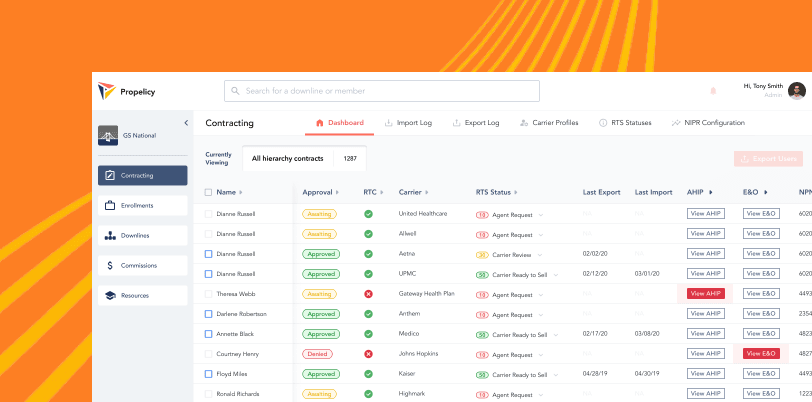
  • Propelicy contracting dashboard on a laptop — a downline contracting table with approval state, carrier, RTS status, AHIP and E&O columns across a full agent hierarchy.
  • Propelicy analytics view on a laptop — a contracting funnel with per-stage counts and a readiness gauge.
The platformThe next-generation multitenant Medicare contracting platform Streaver shipped alongside the existing app — agent contracting at scale, with carrier RTS status, AHIP and E&O tracking in one workspace.
02The Challenge

Four pressures arriving at the same time.

Augmentation engagements often get hired to solve one of these. Propelicy needed all four held at once — capacity, dual-track work, velocity-without-quality-loss, and regulated-domain context — from week one, not after a six-month ramp.

01

A team mid-restructuring, with the roadmap unchanged.

Restructuring removed engineering capacity at exactly the moment the roadmap demanded more, not less. Propelicy needed reinforcements that could read the codebase, the domain, and the team's rhythm — fast — without disrupting any of them.

Capacity gap
02

Build the new platform. Keep the old one healthy.

The legacy app had paying customers on it and could not be allowed to drift. The next-generation multitenant platform had to be built in parallel. Embedded engineers had to be senior enough to hold both tracks without slowing either of them down.

Dual-track work
03

Ship faster, but not looser.

Medicare contracting tolerates very little error: regulated data, audited processes, broker compensation, enrollment deadlines. Shipping faster had to come with a higher bar on testing and review — not a lower one. Velocity without quality loss was the entire ask.

Speed without quality loss
04

A domain that punishes slow learners.

Insurance and Medicare contracting carry compliance constraints most B2B SaaS teams never see — sensitive data, carrier-specific rules, audit-ready histories. Engineers who'd never worked in a regulated industry would have spent the first three months learning what 'safe' meant.

Regulated context
The team is highly talented. When they joined us, our working speed dramatically increased — they successfully replaced a former team, and we consider them all-star power hitters.
Garrett CooperCEO · Propelicy
03Selection

Why Propelicy picked Streaver to plug the gap.

Propelicy was already a strong team — this is not a rescue and not a build. It's the third Streaver pattern: senior engineers embedded inside an existing org, behaving like owners. Four reasons that pattern fit here.

Senior engineers, not contractors.

Propelicy didn't want contractors. The bar was senior full-stack engineers who could open the codebase on day one, identify what needed shipping next, and ship it — without a project manager translating between them and the team. Streaver's senior-only delivery model fit the bar exactly.

Immediate productivity, measured in days.

An augmentation engagement lives or dies on ramp time. Six weeks of onboarding eats most of the value. Streaver's engineers are used to inheriting unfamiliar codebases and contributing in days, not weeks — and the CTO's quote tells you whether that promise held.

Owners, not mercenaries.

The hardest part of augmenting a team isn't the code, it's the culture. The wrong engineer behaves like a mercenary and pulls the rhythm of the room down. Streaver's engineers behave like owners — argue for the right call, take the on-call, raise the bar quietly.

Insurance and regulated context.

Medicare and insurance carry regulatory weight most engineering shops have never worked under. Streaver's engineers had context in regulated, data-sensitive domains and could navigate the trade-offs without a six-month induction.

04The Flip

Four states flipped inside the first two weeks.

Augmentation done well shows up as four state changes, not one big bang: velocity, capacity shape, cultural bar, and architectural scope. Each is named below in Propelicy's own terms where we have a quote, and ours where we don't.

What changed when the team plugged in

  • Team velocity

    Bandwidth-constrained · slow iterationBefore · Mid-restructuring
    Dramatically increased — per CEOAfter · Embed week 2
  • Capacity

    Maintenance-focused · feature backlog growingBefore · Mid-restructuring
    Build new + maintain old in parallelAfter · Embed week 2
  • Engineering culture

    Mid-restructuring · uncertainBefore · Mid-restructuring
    Raised bar · all-star power hittersAfter · Embed week 2
  • Architecture

    Legacy monolith onlyBefore · Mid-restructuring
    Modern API + next-gen multitenant clientAfter · Embed week 2
05Decisions

Three calls that defined the embed.

01

Embed senior full-stack — not a coordinated relay of specialists.

We didn't send specialists you'd have to wire together with a PM. We embedded senior full-stack engineers who could write Nuxt on Monday and Rails on Tuesday, read regulated-domain code without a six-week briefing, and ship to production without a chaperone. Generalists at the senior level move faster than specialists at the same one.

PrincipleIn team augmentation, the right shape is senior full-stack who can hold a thread end-to-end. The wrong shape is a team of specialists held together by coordination overhead.
02

Automate the development cycle, not just the next feature.

Some of the velocity didn't come from writing more code — it came from the boring engineering work the team didn't have capacity for: UI test coverage, error tracing across the stack, faster CI, repeatable deploy paths. We invested in the development cycle so every PR after ours moved faster too, not just our own.

03

Architectural ownership — earned, not granted.

Trust deepened from feature work into architectural decisions. The embedded engineers helped unify the legacy monolith with the new API and the next-generation client app — calls a contractor wouldn't have been allowed to make, and that owners get to make because they earn it.

SignalWhen the CTO sends you architecture decisions, not tickets, the augmentation engagement has stopped being augmentation in the old sense and become a partnership.
06Honest

What this case doesn't prove.

Measurement · honest

We can't show you a velocity chart for this one.

The two C-suite quotes carry this case — but specific velocity metrics (PRs per week, lead time, release frequency) weren't captured systematically at the time. We could rebuild them retroactively from git history, but we'd rather be honest that the proof here is two named C-suite quotes, not a chart.

Subjective · acknowledged

Culture lift is real, and hard to chart.

The 'raised bar' cultural piece is the most valuable outcome and the hardest to quantify. The CTO's quote — 'the culture they've built in such a short time is impressive' — is the closest we can get to a metric, and it's a metric one CTO would have to feel before believing it.

Scope · still-evolving

The engagement is ongoing — duration deliberately open.

The exact engagement duration is in flux because the relationship has been ongoing and re-scoped multiple times. We've left it deliberately open in the meta block — augmentation engagements that work tend to do that, and we'd rather not pretend it's a tidy 12-week sprint.

07Outcomes

What Propelicy's C-suite said the embed delivered.

Each outcome below is paired with the state it replaced. Where the outcome is named by Propelicy's CEO or CTO directly, we use their phrasing. Where it isn't quantified, we mark it as TBD rather than invent a chart.

Bandwidth-constrainedDramatically increased — per CEO

Working speed

The CEO's exact phrase. Velocity lift was felt and named by the leadership team rather than charted — see the Honest section for why we haven't quantified it.

TBD · engineer to verify
Backlog growingShipped in parallel

New API + client app

Maintained and upgraded the existing API; built a next-generation, multitenant client-side application — both in parallel, neither at the expense of the other.

Restructuring · capacity gapEffectively replaced

Former team

The CEO described the embedded engineers as successfully replacing a former team — not in headcount terms, in delivered-output terms.

Mid-restructuringRaised — per CTO

Engineering culture

Higher engineering standards across testing, CI, error tracing, and code review. The CTO's quote names this directly.

Contractor expectationOwner-style

Contribution model

Embedded engineers behave like owners — argue for the right architectural call, take on-call, raise the bar — instead of clearing tickets and going home.

Feature-work onlyArchitecture decisions delegated

Trust depth

Trust extended from feature work into architectural decisions — unifying the monolith with the new API and the next-generation client.

Streaver was vital in helping us ship faster by augmenting our team when needed. We sent countless lines of code to production together. The culture they've built in such a short time is impressive — working with them has been a true delight.
Manuel Barros ReyesCTO · Propelicy
08The Team

Senior full-stack, embedded inside Propelicy's org.

Augmentation works when the engineers behave like part of the team they joined — same standups, same review cadence, same on-call expectations — not as a parallel vendor team measured by ticket throughput.

S
Senior Full-Stack 1TBD
Senior Full-Stack

Embedded full-stack. Holds threads end-to-end across Nuxt and Rails. Pairs daily with Propelicy's product engineers.

S
Senior Full-Stack 2TBD
Senior Full-Stack

Embedded full-stack. Owns the next-generation multitenant client surface and the API contract that backs it.

A
Architecture LeadTBD
Senior Engineer · Architecture

Architecture lead inside the engagement. Helped unify the legacy monolith with the new API and the next-gen client app.

F
Frontend EngineerTBD
Senior Frontend

Frontend engineer focused on UI testing, design-system adherence, and the next-gen multitenant client experience.

How the engagement is structured

Cadence

Streaver engineers sit in Propelicy's daily standups, sprint planning, and retros. Not a parallel team with a parallel cadence — the same cadence as the Propelicy product team they augment.

Communication

Slack-first, async-default, with face time in the standups and on architecture reviews. Documentation lives in Propelicy's tools so it survives any future change of vendor or team composition.

Pricing

Time-and-materials with an explicit ramp-down clause. Augmentation pricing — the engagement scales up or down as Propelicy's capacity needs change, with no cliff for either side.

IP & trust

All code, infrastructure, and architectural decisions are Propelicy's IP from the first commit. Streaver does not retain rights, credentials, or institutional knowledge that Propelicy doesn't have a copy of.

The embed, traced

WEEK 00OnboardingEmbedded engineers onboarded into Propelicy's repositories, standups, and review cadence. Read-only on the highest-risk surfaces for the first week.
WEEK 02First shipmentsFirst shipments to production — small, low-risk PRs to establish review rhythm and unblock the Propelicy team's hottest tickets.
WEEK 08API foundationAPI foundation work for the next-generation multitenant platform. Existing app stays healthy in parallel.
WEEK 16Client app buildNext-generation client app development underway. UI testing, error tracing, and CI improvements ship alongside features.
WEEK 26Capacity steady-stateCapacity hold becomes the new steady state. The CEO publicly names the embedded engineers as 'all-star power hitters' who replaced a former team.
WEEK 52Architectural trustArchitectural decisions delegated to the embedded engineers — unifying the legacy monolith with the new API and the next-gen client app.
09Stack

The actual Propelicy stack — Nuxt, Rails, Postgres.

Senior full-stack engineers are useful precisely because the stack here spans the JavaScript/TypeScript world and the Ruby world. The embed had to be productive in both — same week, sometimes same PR.

Languages & Frontend

  • TypeScriptstrict, across the next-gen client
  • JavaScriptlegacy surfaces, being modernized
  • Nuxt.jsnext-generation multitenant client
  • Tailwindutility-first styling across surfaces

Backend & Data

  • Ruby on Railscore application server, monolith + new API
  • PostgreSQLprimary relational store
  • Redisqueues, caching, background work

Infrastructure

  • Herokuprimary application hosting
  • AWSobject storage, supporting services
10What's Next

Where Propelicy is going next.

The capacity gap is closed and the next-generation platform is shipping. The next phase is about turning Propelicy into the spine of Medicare contracting — multitenant maturity, compliance automation, and a third-party API ecosystem.

Multitenant platform maturity.

Continuing to mature the next-generation multitenant platform — onboarding additional carriers and FMOs onto it, retiring legacy surfaces only as the customer base allows. Modernization where it earns its keep, never for its own sake.

Compliance automation for Medicare contracting.

Automating Medicare-specific compliance and validation rules so that what is today checked in review can be checked by the platform itself — fewer audit surprises, faster cycle time, and a moat against the rest of the industry's spreadsheet stack.

Third-party API ecosystem.

A third-party API ecosystem for FMOs, carriers, and downstream agency tools — so Propelicy's platform becomes the spine that the rest of the broker tooling plugs into, instead of yet another silo in the broker stack.

Short an engineering team — but not your standards?

Let's embed power hitters.

Need senior engineers who can integrate in days, not weeks — and behave like owners? Streaver embeds senior full-stack engineers inside product orgs that are mid-restructuring, short a team, or outgrowing their hiring pipeline. Owner-style contribution from day one.

11Continue reading
DELOS AG
Featured
Live

DELOS AG

First paying enterprise customers in sixteen weeks

91% precision · 4-agent systemRead the case study
Supreme Golf
Featured
Live

Supreme Golf

Building a $1M product for $125K with a non-technical CEO at the keyboard

8× lower cost · 3–5 deploys/dayRead the case study