Case Study · 0138-week MVP · live across PRN events

Check-in, 80% faster — and 30+ staff hours back every event.

Streaver built PRN a custom badge and check-in platform that turned a slow, manual registration into a scan-confirm-print experience that takes seconds — at a fraction of the cost of the commercial tools.

Client
PRN Badge App
Sector
Nonprofit · Events · Robotics & AI
Engagement
Custom event platform
Build
8-week MVP
Live at
Pittsburgh Robotics Network events
Model
Fixed-fee build · per-event ops
80%Reduction in average check-in time
30+ hrsStaff hours saved per event
8 wksFrom kickoff to live MVP
TBDAttendee satisfaction liftTBD
01A nonprofit's events deserved a better first impression.

When the first thirty seconds of every event was the weakest thing about them.

Organization
Pittsburgh Robotics Network
Type
Nonprofit · ecosystem builder
Focus
Robotics & AI
Events
Frequent, high-attendance
Engagement model
Custom build · per-event support

The Pittsburgh Robotics Network (PRN) is a nonprofit building the robotics and AI ecosystem in and around Pittsburgh. Frequent, high-impact events are how members meet, partner, hire, and find one another — the events are the product, and the first thirty seconds of each one are the moment that sets the tone.

Those first thirty seconds weren't working. Check-in was manual, slow, and error-prone. A line built up at the door. Staff who should have been running the event were running a clipboard. And the badge itself — the cheapest networking tool in the room — carried none of the signal that membership tier would have given it.

Commercial event platforms could have solved the mechanics, but they were priced for corporate conferences, not nonprofit ecosystems. None of them integrated with PRN's membership system. None of them could put a member's tier on a badge. PRN needed something the market didn't sell.
02The Challenge

Four problems the off-the-shelf tools didn't solve.

The mechanics of check-in are a solved problem at corporate-budget prices. PRN had to solve them at nonprofit-budget prices, with the membership system wired in, and with hardware that didn't simply move the bottleneck from the staff table to the printer.

01

A manual check-in bottleneck

A manual table, a printed list, a marker, and a staff member double-checking spellings. Lines built up before the event began. The single biggest event-day headache, every event, and it scaled badly with growth.

Operations
02

Commercial tools unaffordable, and membership-blind

Commercial event platforms could automate the mechanics — for corporate-conference money. Nothing on the market was priced for a nonprofit's recurring event budget, and nothing integrated with PRN's membership system out of the box.

Cost & Fit
03

No membership tier on badges

A badge is the cheapest networking tool in the room — if it carries signal. Without membership tier on it, attendees couldn't see who was who at a glance, and PRN was leaving the most useful five seconds of every interaction on the table.

Networking
04

Multi-printer, multi-location at scale

Once check-in goes self-service, the printer is the new bottleneck. A single thermal printer at a single table doesn't scale to event volume — and multi-location events make the problem worse. The print path had to be a distributed system, not a peripheral.

Hardware
Check-in used to be our biggest event-day headache. Now attendees print their own badges in seconds and our team is free to actually run the event.
Josh LucasTBDDirector of Programs · Pittsburgh Robotics Network
03Selection

Why PRN built with us instead of buying.

PRN ran the buy-vs-build math honestly. The buy path was the wrong shape — wrong price, wrong integrations, wrong product surface for the badge. We came in built to the actual requirement, not to a license tier.

Custom-fit for a nonprofit's budget.

PRN didn't need an enterprise platform with features it would never use. It needed exactly the platform its events required, at a fraction of the cost of the commercial tools. Streaver built to the actual requirement — not to a license tier — and the math worked the moment we sketched it.

Membership-aware by design.

The badge had to know who the attendee was — not just by name, but by membership tier. That meant the platform had to talk to PRN's membership system from day one, not as an integration scoped for v2. Streaver designed the data model around the membership signal, not around event registration alone.

Distributed printing as a system, not a peripheral.

Self-service check-in only works if the print path doesn't bottleneck. Streaver had operated distributed hardware before and treated the print server as a first-class system component: multiple thermal printers, multiple locations, deterministic routing, no single point of failure on the door.

04The Flip

The same event, half the friction.

Four things flipped between the old check-in and the new one. None of them are flashy on their own — they are the ordinary mechanics of an event door, run well. Together they are why the line stops being a line.

+ Image placeholder

QR scan + badge print in action — short video or sequence of stills of an attendee scanning, confirming, and walking off with a freshly printed, branded badge.

Before · After · the same event, half the friction

  • Check-in time

    Manual · slow · error-proneBefore · Manual table
    Scan · confirm · print · secondsAfter · Self-service
  • Staff burden

    30+ hours per event on check-inBefore · Manual table
    Free to run the event itselfAfter · Self-service
  • First impression

    Manual table · queueingBefore · Manual table
    Instant · branded · professionalAfter · Self-service
  • Networking signal

    No tier visibility on badgesBefore · Manual table
    Membership tier on every badgeAfter · Self-service
05Decisions

Three calls that defined the platform.

01

Self-service QR check-in — attendees scan their own code.

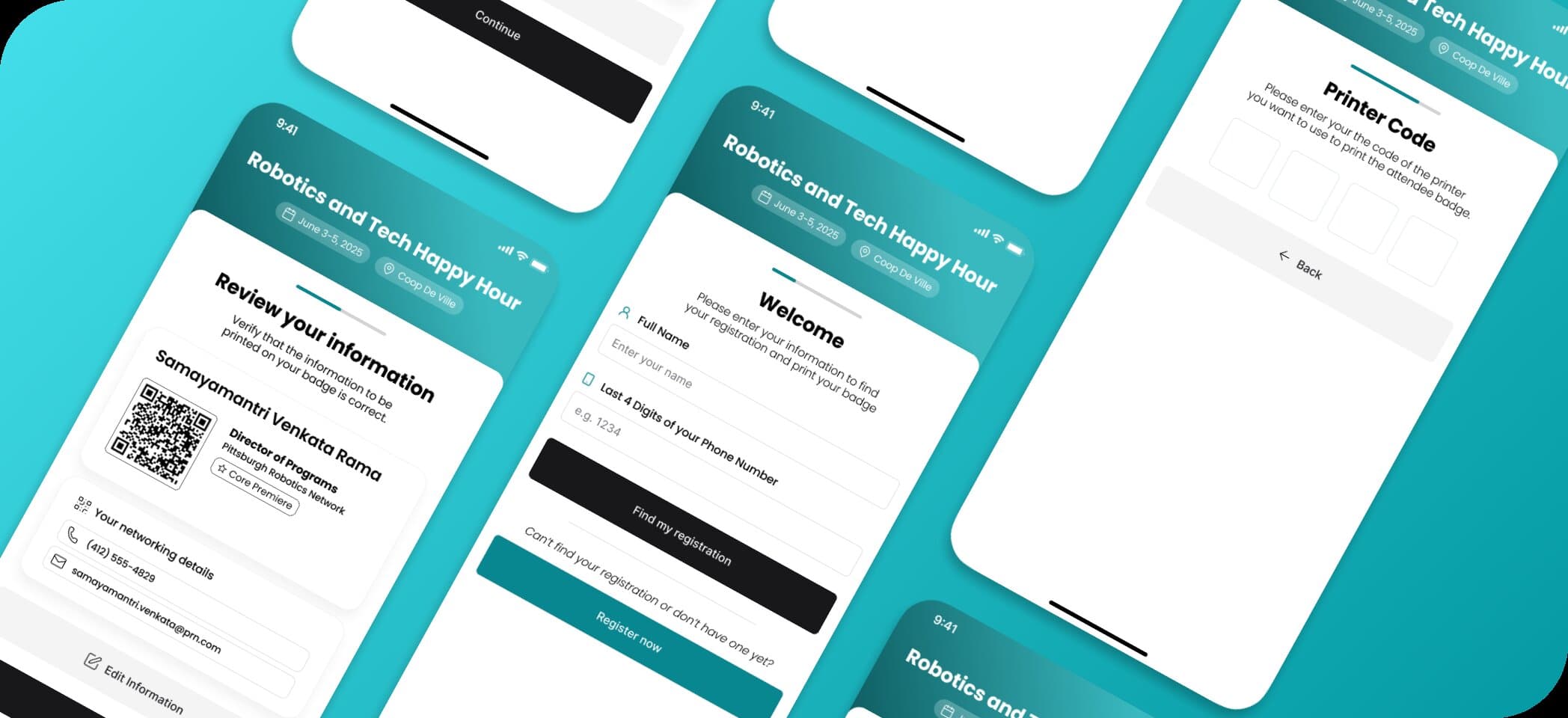
We made the attendee the actor. A QR code in the confirmation email, scanned at any open kiosk, name and last-four-of-phone to confirm, and a badge in their hand in seconds. No staff in the critical path. The line stops being a line the moment the attendee starts moving on their own.

ResultCheck-in time fell by 80%. Staff time per event came back by 30+ hours. The biggest event-day headache stopped being the biggest event-day headache.
02

Membership tier on every badge — status, at a glance.

We put membership tier on the badge — Core Premiere, Core Silver, Network Gold — in PRN's branded design. Status is visible at a glance, and a quick scan of someone else's QR saves their contact instantly. The badge stopped being a name tag and started being a networking device.

Why it mattersThe badge is the cheapest piece of software in the room. Treating it as a product surface, not a label, is the difference between a name tag and a network.
03

Distributed thermal printing — no bottleneck on the door.

We split the print path across multiple thermal printers, driven by a dedicated print server, addressable across event locations. Attendees scan, the server routes the job to the nearest available printer, and the badge prints in seconds. The hardware is invisible when it works — which is the whole job.

PrincipleSelf-service only earns its name if the bottleneck doesn't just move from the staff table to the printer. Distributed printing is the part nobody photographs and the part that actually makes the rest work.
  • Three PRN event badges, each showing an attendee's name, title, company, QR code and membership tier — Core Premiere, Core Silver and Network Gold.
The badgeEvery badge carries the attendee's QR code and membership tier — Core Premiere, Core Silver, Network Gold — printed in PRN's branded design at the door.
06Honest

What we can prove. What we haven't measured yet.

Not measured yet

Post-launch attendee growth isn't isolated.

We can show check-in time, staff hours, and delivery speed. We can't yet show what happened to attendance volume after launch — PRN's growth has multiple drivers and we'd rather not claim a number we can't isolate. Working with the team on a clean attribution for the next renewal.

Anecdotal, not instrumented

We haven't measured the networking lift yet.

Anecdotally, the QR-scan-to-save-contact flow gets used heavily — but we haven't instrumented it. The networking lift from the badge is real in the room and unmeasured on the dashboard. A pass to add lightweight, privacy-respecting analytics is on the roadmap.

Confirm on renewal

The Eventbrite / MemberClicks split needs re-confirming.

The platform pulls registration data from Eventbrite and membership/tier data from MemberClicks, consolidated into one model. That split is current at the time of writing — but membership tooling moves, and we'd want to confirm it on every renewal cycle, not assume it.

07Outcomes

The numbers that show up on the door.

Each outcome below is paired with the baseline it's measured against. The figures with TBD badges are the ones we'd like PRN's team to confirm with instrumentation before quoting publicly.

Manual table · clipboard · queueScan · confirm · print · seconds

80% faster check-in

Average check-in time fell by 80%. The line stops being a line the moment the attendee becomes the actor.

30+ hours on check-in mechanicsFree to run the event

30+ staff hours back per event

Staff time on registration, reconciliation, and manual badge-writing came back to the team — to spend on the event itself.

Manual table · queueingInstant · branded · professional

A first impression that matches the event

The first thirty seconds of each event finally matched the rest of it. The badge handed to an attendee is now part of the brand, not a hand-written exception to it.

Business cards · LinkedIn lookupQR-scan to save contact

Built-in networking

Two attendees who want to keep in touch scan each other's badges and the contact is saved. Networking moved from intention to one tap.

TBD · engineer to verify
Name onlyCore Premiere · Core Silver · Network Gold

Membership tier visibility

Membership tier is visible at a glance on every badge. Status, signal, and a real reason to upgrade are all in the room without anyone announcing them.

Per-event spreadsheetsRepeatable platform across the series

A platform, not a one-off

What started as a single-event tool is now the standing platform for every PRN event — and the same engine fits any membership-driven event series.

08The Team

A small build team. A hardware specialist on the door.

Four engineers shipped the eight-week MVP. The same group runs the event-week support cadence — same Slack channel, same hands on the print server when the door opens.

E
Engineering LeadTBD
Engineering Lead

Scoped the build, runs the per-event ops cadence, and owns the relationship with PRN's programs team.

B
Backend EngineerTBD
Backend · Integrations

Owns the Eventbrite and MemberClicks integrations and the consolidated data model behind the badge.

F
Frontend EngineerTBD
Frontend · Check-in & Admin

Built the self-service check-in flow and the admin tools PRN uses to run the event on the day.

H
Hardware EngineerTBD
Hardware / Print Engineering

Owns the print server, the thermal printer fleet, and the multi-location routing logic that keeps the door moving.

How the engagement is structured

Cadence

Weekly product check-in with PRN during the build. Event-week stand-ups switch to on-site or on-call hardware support — Streaver is in the room (or one ping away) the day of the event.

Communication

Shared Slack channel between the joint team. PRN holds full access to every repo, every credential, every dashboard. The platform is PRN's, not a vendor-locked black box.

Pricing

Fixed-fee build for the eight-week MVP. Per-event operational support priced as a small flat fee, not a per-attendee SaaS tax. The pricing reflects a nonprofit's budget, not a corporate license tier.

IP & ownership

Source, deployment, and operational ownership transfer to PRN at the end of the build. Streaver continues as the engineering partner, but PRN holds the option to take it fully in-house at any time.

Eight weeks, traced

WEEK 00Kickoff & designKickoff with PRN's programs team. Sketched the user flow, the data model, and the hardware footprint. First decisions made by end of week.
WEEK 02MVP web platformWeb platform MVP live in staging: self-service check-in flow, attendee confirmation, admin tools for manual overrides.
WEEK 04Distributed printing onlinePrint server up. Multiple thermal printers driven from one source, routing logic for multi-location events tested under load.
WEEK 06Membership system syncedEventbrite registration data and MemberClicks membership data consolidated into the badge model. Tier visible on the printed badge.
WEEK 08Live · first eventLive at the first PRN event of the engagement. 80% faster check-in measured on the door. 30+ staff hours saved against the prior baseline.
09Stack

Boring tech where it matters. Hardware where it's the work.

The platform itself uses ordinary, dependable pieces. The thermal printer fleet and the print server are the part that earns the engineering attention — that's where the bottleneck would otherwise reappear.

Languages & Frontend

  • TypeScriptstrict, across the platform
  • JavaScriptshared utilities & print client

Backend & Data

  • Node.jsAPI & integration runtime
  • PostgreSQLunified attendee + membership data model

Hardware & Infrastructure

  • Thermal printersfleet across event locations
  • Print serverdeterministic job routing
  • AWSplatform hosting

Integrations

  • Eventbrite APIevent registration source
  • MemberClicks APImembership & tier data
  • QR generationper-attendee identity on the badge
10What's Next

From a working check-in to a network in the room.

The door problem is solved. The next phase is about turning the badge into the entry point for a richer networking and analytics layer — and scaling the same engine to PRN's larger events.

Enhanced networking layer.

Richer attendee profiles and a deeper badge-scan flow: scan to view a public profile, save the contact, follow up after the event. The badge becomes the entry point to the network, not just a label of who's in it.

Post-event analytics.

Lightweight, privacy-respecting post-event analytics: attendance, engagement, networking activity. Replace the anecdotes ("it felt busier this year") with numbers PRN can act on between events.

Multi-event, multi-day scaling.

Multi-event, multi-day scaling — concurrent sessions, multi-track conferences, badge re-print at scale. The platform is already designed for the event series; the next phase tunes it for the larger events on PRN's calendar.

Running events that deserve a better first impression?

Let's build the check-in your attendees remember.

Frequent events on a nonprofit budget? We built a check-in that beats the commercial tools — for a fraction of the cost. Same engine fits any membership-driven event series.

11Continue reading
DELOS AG
Featured
Live

DELOS AG

First paying enterprise customers in sixteen weeks

91% precision · 4-agent systemRead the case study
Supreme Golf
Featured
Live

Supreme Golf

Building a $1M product for $125K with a non-technical CEO at the keyboard

8× lower cost · 3–5 deploys/dayRead the case study